The industrial and regulatory landscape is changing at lightning speed. Global mandates—from Extended Producer Responsibility (EPR) to stringent ESG (Environmental, Social, and Governance) reporting—are moving the goalposts for every major company, especially Multinational Corporations (MNCs).
Compliance is no longer a check-the-box activity; it’s an audit-ready, data-intensive requirement that carries the weight of hefty fines and reputational damage. This is where a purpose-built digital marketplace like ScrapEco steps in. It’s not just a platform to sell scrap; it’s the digital backbone that allows MNCs and industrial sellers to transform their waste management from a costly liability into a compliant, transparent, and profitable operation.
Benefits for MNCs and Large Industrial Manufacturers: From Compliance Burden to Competitive Edge
For MNCs, the stakes are highest. They face global scrutiny on their supply chains and environmental impact. ScrapEco provides the structure needed to meet these demands without the typical manual chaos.
1. Failsafe Regulatory Compliance and Fine Prevention
The biggest threat to an MNC is the financial and reputational damage from non-compliance. ScrapEco is engineered to eliminate this risk.
* Audit-Ready Traceability: Every single transaction—from waste generation to final recycling—is digitally recorded, GPS-tracked, and time-stamped. This provides an unassailable, transparent audit trail required for government submissions. It’s the proof you need to show regulators and investors that your waste ended up in the right, legitimate hands.
* Seamless EPR Credit Management: For EPR obligations (especially for plastic and e-waste), compliance requires securing credits from certified recyclers. ScrapEco simplifies this complex process by acting as a verified, legitimate marketplace for EPR credit transfer, ensuring you meet your annual targets on time and without running afoul of regulatory requirements.
* Mandate-Compliant Documentation: The platform automates the generation of crucial documents, including weight slips, invoices, and material receipt confirmations, ensuring they are always in the standardized format required for annual compliance reports.
- Superior Data for ESG Reporting and Investor Relations
ESG scores directly impact valuation and investor confidence. ScrapEco provides the precise, verifiable “E” (Environmental) data needed to boost your standing.
* Real-Time Data Insights: Instantly access metrics on the volume of material recycled, resource conservation, and even estimated carbon reduction achieved through responsible disposal.
* Centralized Reporting Hub: Instead of chasing data from multiple plant locations and third-party vendors, all waste-related statistics are aggregated on a single dashboard, making the compilation of your annual Sustainability Report or ESG Disclosure a matter of a few clicks.
* Mitigating Supply Chain Risk: By dealing exclusively with verified, certified recyclers and traders on the platform, you ensure that your waste is processed legally, protecting your company’s reputation from association with informal or illegal waste dumping practices.
- Operational Efficiency and Profit Maximization
A digital marketplace converts waste from a cost center into a revenue stream.
* Optimized Price Realization: ScrapEco’s transparent, competitive e-auction and bidding system ensures your industrial scrap (ferrous, non-ferrous, plastic, e-waste) always fetches the best prevailing market price, maximizing your revenue from materials that were once considered liabilities.
* Streamlined Logistics: The platform coordinates the entire logistics process, including pickup scheduling and delivery, reducing the administrative burden on your plant managers and ensuring timely material evacuation to keep your production area clutter-free and safe.

Benefits for Industrial Waste Management Sellers (Recyclers, Aggregators, Vendors)
ScrapEco is equally transformative for the certified recyclers and scrap aggregators who form the backbone of the circular economy.
- Access to High-Value, Verified Supply
* Direct Access to MNC Scrap: Sellers gain direct access to a consistent, high-volume supply of industrial scrap materials listed by verified MNCs and large manufacturers, eliminating the typical hassle and expense of complex sourcing.
* Transparent Material Assurance: Listings often come with verified quantity and quality details, reducing negotiation friction and the risk of unexpected material inconsistencies upon pickup.This led to the biggest shift wherein, scrap buyers who adopted digital documentation and transparent reporting became the company’s preferred long-term partners, securing multi-year contracts and predictable volumes. This is the new competitive advantage in the Indian scrap industry.
- Fair and Transparent Commerce
* Competitive Price Discovery: The auction-based model ensures a fair, market-driven price for the scrap materials. This transparency fosters trust and allows sellers to budget accurately.
* Secure Transactions: The portal facilitates digital contracts and secure payment gateways, eliminating cash-based risks, ensuring timely payment, and providing a clean financial trail for the seller’s own accounting and tax purposes.
- Digital Credibility and Business Growth
* Enhanced Credibility: Being a verified seller or recycler on a platform dealing with top MNCs immediately elevates your company’s profile and credibility within the industry.
* Scalability: The digital network allows sellers to bid on contracts across a wider geographical area than traditional manual sourcing, facilitating rapid business expansion and scale.
The ScrapEco Difference: Beyond Just Buying and Selling
ScrapEco represents a strategic shift. It is the necessary bridge between the industrial output of waste and the demanding compliance requirements of the 21st century.
It’s the tool that ensures zero fines due to non-compliance, generates verifiable data for top-tier ESG scores, and provides maximum profitability from a neglected asset.
It’s time to retire the messy, manual, paper-based system of industrial waste management and embrace the future—where compliance is digital, transactions are transparent, and sustainability is profitable.
Are you ready to digitize your compliance and turn your scrap into a strategic asset?
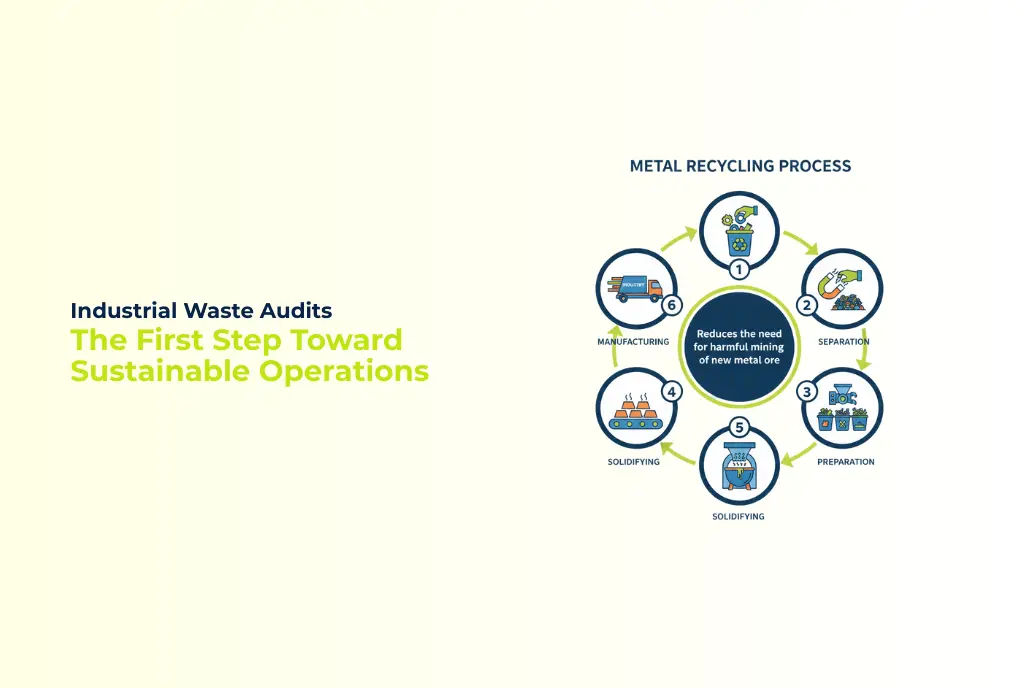
Industrial Waste Audits: The First Step Toward Sustainable Operations
Industrial waste management used to be reactive. Plants generated scrap, moved it out through local buyers, and closed the loop with a few signatures and receipts. That world no longer works; not for regulators, not for ESG commitments, and definitely not for industries trying to optimise operations. Today, the smartest factories treat industrial waste audits as a core operational discipline rather than a compliance formality.
Because when an audit is done thoughtfully, it reveals the truth that many operations miss:
waste is not an environmental liability, it’s a financial data point waiting to be decoded.
A well-executed waste audit answers simple but transformative questions:
- What material streams leave the plant each week?
- How much value is locked inside those streams?
- How consistent is the grading and weighing process?
- Are scrap buyers and recyclers verified and compliant?
- Are we losing money due to manual logging or non-standardised scrap sales?
The problem is that many organisations still run audits manually using clipboards, spreadsheets, WhatsApp images, and siloed vendor interactions. This not only limits visibility but leads to different versions of the “truth” across departments.
This is where digitised audit support systems are changing the landscape. Platforms like Scrapeco bring structure to the fundamentals: Digital Scrap Registers, scheduled scrap pickups, verified buyers, GPS-tracked movement, and photo-based documentation. These capabilities make audits sharper, data-rich, and audit-ready at any point in time.
Industry leadership today is less about cutting emissions overnight and more about building systems where every scrap of data becomes traceable and defensible.
Why modern industrial waste audits matter more now than ever
- They eliminate blind spots: Plants discover leakages, process inefficiencies, and misclassified waste categories.
- They unlock monetary value: Streamlined scrap sales and verified “old scrap buyers near me” push prices up and reduce negotiation chaos.
- They prepare industries for EPR and ESG regimes: With ready digital logs, manufacturers are always audit-compliant.
- They drive internal accountability: When every batch is logged through a scrap register, waste stops being invisible.
A realistic example from Indian manufacturing
Consider a mid-sized auto components manufacturer planning its transition toward ISO 14001. The plant generated around 650 tonnes of mixed scrap annually, but records came from four different supervisors, five different buyers, and inconsistent weighing scales.
Upon conducting a structured digital audit using technology similar to Scrapeco’s stack:
- Variance between reported and actual scrap volumes dropped by 18%.
- Stream segregation accuracy improved by 32%.
- Revenue from ferrous scrap sales increased by 11% simply because verified buyers offered competitive bids.
- GPS tracking eliminated disputes around pickup timing, weighing, and vehicle routing.
The result? A clear, data-backed narrative that the company could present to the board, investors, and compliance authorities without fear.
The future: Smart waste audit tools
The industry is moving toward:
- AI-powered material recognition
- Automated RC and POD generation
- Predictive scrap generation modelling
- Integrated compliance dashboards
Once industrial waste audits evolve into real-time intelligence systems, operations will stop reacting to waste instead they will anticipate it.
If waste is one of the most measurable outputs of your operations, what would change in your business if you could measure it perfectly?